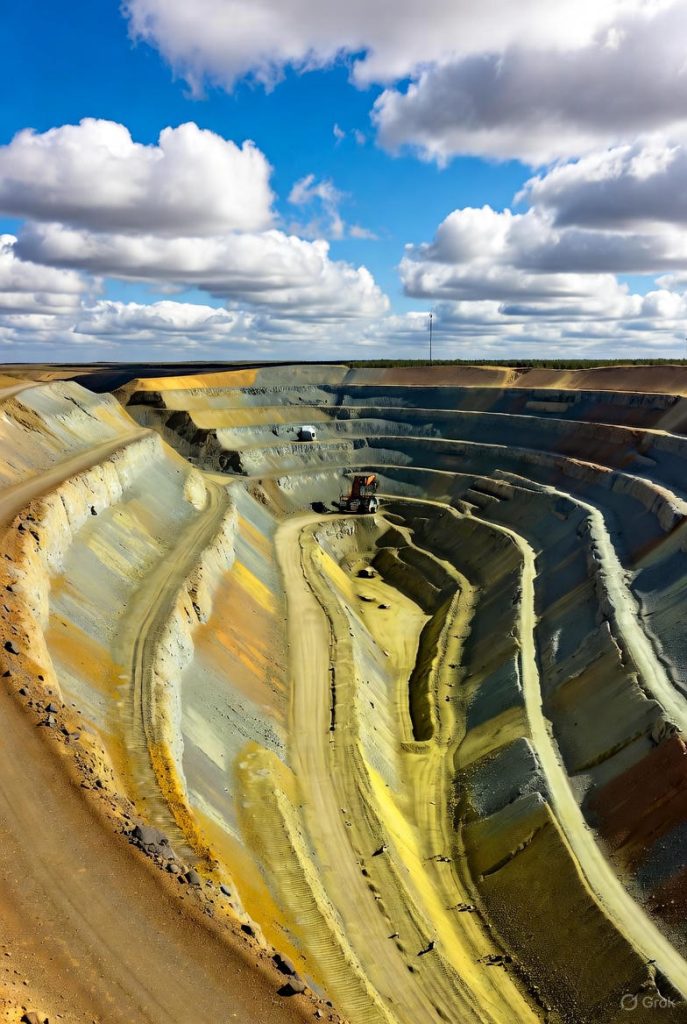

The United States has had its own uranium mining operations for decades, starting in the late 1800s but really ramping up during the 1940s for the Manhattan Project. Major sites were in places like Colorado, Utah, and Wyoming. Mining peaked in the ’50s and ’60s but slowed down after the 1980s due to cheaper imports and environmental regulations. Previously, domestic production was limited, with only a few active mines in Wyoming and Texas, like the White Mesa Mill in Utah. Most uranium comes from Canada and Kazakhstan, and we still have reserves-about 47,000 tons, according to recent data.
Three new uranium mines started production late last year in Arizona and Utah, run by Energy Fuels-Pinyon Plain, La Sal, and Pandora. They’re ramping up now, with Pinyon Plain hitting record output in April, like 151,000 pounds of uranium concentrate. More are planned: Energy Fuels is eyeing two additional mines in Colorado and Wyoming for next year, and Uranium Energy Corp’s pushing for a new refining and conversion facility. Plus, enCore Energy’s Dewey Burdock project in South Dakota got fast-track permitting for in-situ recovery.
The permitting process for a uranium mine in the United States is a multi-layered federal and state endeavor, primarily overseen by agencies like the Nuclear Regulatory Commission (NRC) for safety and licensing, the Bureau of Land Management (BLM) for public land use, the Environmental Protection Agency (EPA) for water and air quality impacts, and the Department of Energy (DOE) for broader energy security considerations. Under the National Environmental Policy Act (NEPA), developers must conduct extensive environmental impact assessments, often resulting in thousands of pages of documentation, public consultations, and potential litigation that can stretch timelines to several years—or even decades in complex cases. Historically, this regulatory framework has slowed domestic uranium production, contributing to heavy reliance on imports, but recent government actions have aimed to accelerate approvals for critical minerals like uranium to bolster national security and energy independence.
A pivotal shift recently came with the Energy Permitting Reform Act of 2024, which shortens review timelines before, during, and after litigation for energy and mineral projects, including uranium mines, while preserving core environmental and safety standards. This bipartisan measure, introduced by Senators John Barrasso and Joe Manchin, represents a direct congressional push to cut bureaucratic delays that have hampered domestic output. Complementing this, President Trump’s declaration of a National Energy Emergency on January 20, 2025, triggered emergency procedures allowing for dramatically expedited reviews, such as a new 14-day environmental assessment process for high-priority energy projects— a stark contrast to the multi-year norm. This was first applied to Anfield Energy’s Velvet-Wood uranium-vanadium mine in Utah, which received BLM approval in May 2025 after just two weeks of review, enabling underground mining on just three acres of new disturbance and supporting restarts at nearby mills like Shootaring Canyon.
Further momentum built through a March 2025 Executive Order on Immediate Measures to Increase American Mineral Production, which waived select statutory requirements (under 50 U.S.C. 4533) and directed agencies like the Interior, Defense, Agriculture, and Energy departments to prioritize and fast-track uranium projects within 10 days of submission. Uranium was explicitly classified as a critical mineral under this order, alongside others like copper and gold, to address vulnerabilities exposed by foreign dominance—such as 99% import reliance in 2023. The order emphasizes rapid permitting for sites that could quickly enhance supply chains, with agencies coordinating via the National Energy Dominance Council.
These policies have fed into programs like FAST-41 (Fixing America’s Surface Transportation Act Section 41001), which provides transparency, milestones, and expedited coordination for critical infrastructure projects. In September 2025, the Trump administration enrolled enCore Energy’s Dewey-Burdock in-situ recovery project in South Dakota into FAST-41, aiming to revive a long-stalled proposal through streamlined federal reviews and reduced redundancy across agencies. Additionally, the 2024 prohibition on Russian uranium imports (phasing out by 2028) has indirectly pressured faster domestic permitting by creating supply urgency for nuclear plants. The Department of the Interior’s draft 2025 Critical Minerals List, released in August 2025, further influences this by flagging uranium for prioritized federal investments and permitting, with public comments open until late September on its inclusion.
While these reforms have spurred a resurgence—U.S. uranium production jumped to 677,000 pounds in 2024, with more in-situ facilities coming online—they haven’t eliminated all hurdles. Developers still face state-level requirements, reclamation bonds, and ongoing NEPA litigation risks, and critics argue the rush could overlook long-term environmental costs. Overall, the government’s recent interventions mark a strategic pivot toward “energy dominance,” making it easier than in prior decades to get a mine operational.
Job Creation and Workforce Expansion
A primary boon is the creation of high-wage jobs in mining, processing, and related sectors. The Department of Energy (DOE) projects that expanding nuclear capacity to 200 gigawatts by 2050—fueled in part by reliable domestic uranium—could require an additional 375,000 workers nationwide, with uranium mining alone potentially adding thousands in states like Wyoming, Utah, Colorado, and South Dakota. In the Western U.S., the Mineral Executive Order is forecasted to generate up to 50,000 direct and indirect jobs across critical mineral extraction, including uranium, by easing access to federal lands and prioritizing federal funding for projects. These roles, often paying 20–30% above the national average, will particularly revitalize rural economies hit hard by past mine closures.
GDP Growth and Regional Economic Stimulation
The reforms are anticipated to contribute $50–100 billion annually to U.S. GDP by 2030 through increased mineral production and downstream nuclear industry activity, per White House analyses of broader energy unleashing initiatives. In mining-heavy Western states, uranium-specific expansions could add 1–2% to state GDPs; for instance, Colorado and Utah might see $2–5 billion in annual economic output from new uranium-vanadium projects alone, including royalties, taxes, and supply chain spending. Nationally, the uranium price rally—up nearly 29% since March 2025 to around $83 per pound—has already boosted producer revenues, with companies like Uranium Energy Corp reporting $66.8 million in first-half 2025 sales and a debt-free balance sheet supporting further investments. This influx encourages private capital, with uranium stocks surging (e.g., 24.8% for Uranium Energy in September 2025) amid government-backed production incentives.
Energy Cost Savings and Supply Chain Resilience
By curbing import vulnerabilities—especially from Russia, banned through 2028—these policies will stabilize nuclear fuel costs, which power 20% of U.S. electricity. This could save utilities and consumers $10–20 billion yearly in fuel procurement by 2028, indirectly lowering electricity rates by 5–10% in nuclear-dependent regions and bolstering manufacturing competitiveness. Enhanced domestic enrichment, backed by $2.72 billion in 2024 appropriations for high-assay low-enriched uranium (HALEU), will further secure supply chains for advanced reactors, potentially adding $30 billion in economic value from reduced foreign dependency. Overall, these steps align with an “all-of-the-above” energy strategy, fostering long-term growth in clean energy exports and innovation.
While environmental mitigation costs and potential litigation could temper short-term gains, the net economic uplift is projected to outweigh them, positioning uranium as a cornerstone of U.S. energy dominance and industrial revival.