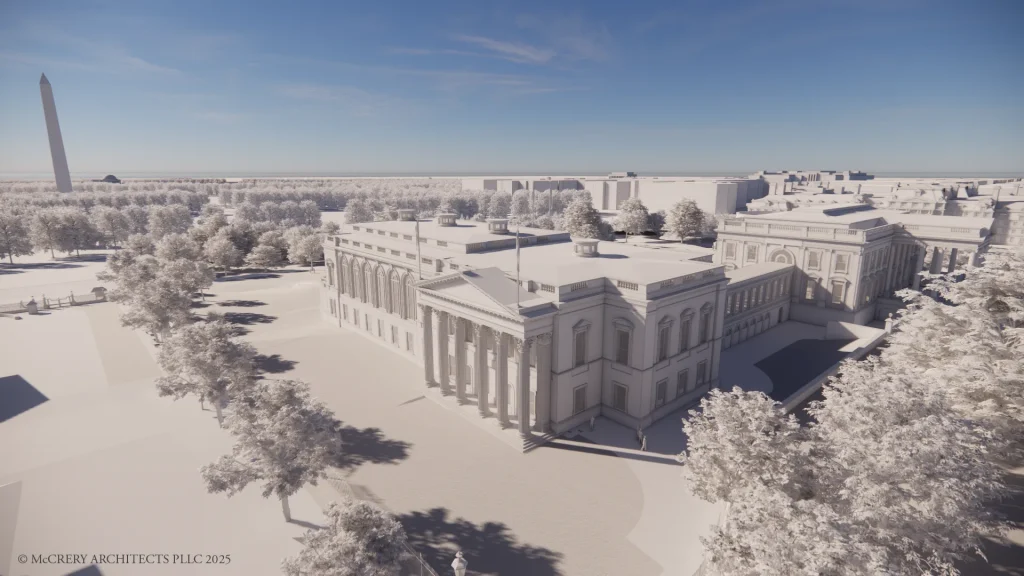

In a dramatic disclosure aboard Air Force One on March 29, 2026, President Donald Trump lifted the veil on one of the most audacious White House construction projects in modern history. While holding up architectural renderings of a gleaming new 90,000-square-foot ballroom destined to replace the demolished East Wing, Trump casually confirmed what had been rumored for months: beneath the opulent event space, the U.S. military is building a “massive complex” – a fortified underground installation designed for national security in an era of drones, missiles, and escalating global threats. “The ballroom essentially becomes a shed for what’s being built under by the military,” he told reporters, describing the above-ground structure as both a ballroom and a protective shield.
The revelation came just days after a federal judge weighed in on a lawsuit filed by historic preservationists, and it transformed what had been portrayed as a lavish, privately funded upgrade into a dual-purpose national-security project. What began as a plan to modernize White House event space has evolved into a lightning rod for controversy, pitting presidential ambition and security needs against historic preservation, congressional oversight, and public transparency. This article examines the full scope of the ballroom upgrade, the military installation hidden beneath it, the lawsuit that forced the details into the open, and the broader implications for the seat of American power.
The Origins of the Ballroom Project: From East Wing Demolition to Grand Vision
The story traces back to the summer of 2025. On July 31, the White House issued a formal statement announcing the construction of a new “State Ballroom” – an “exquisite addition” of approximately 90,000 square feet with ornately designed interiors and a seated capacity of 650 people, more than triple the 200-person limit of the historic East Room. The project was framed as a long-overdue enhancement to the executive mansion, which had struggled to host large-scale state dinners, diplomatic receptions, and public events without spilling into temporary tents on the South Lawn.
By October 2025, President Trump had ordered the demolition of the East Wing, a structure originally built in 1942 to house the First Lady’s offices, staff workspaces, and a bomb shelter. The wing’s removal cleared the way for the new ballroom, which Trump envisioned as “almost a twin to the White House” in scale and grandeur. Architectural plans released later featured Corinthian columns, bulletproof glass windows, a “drone-proof” reinforced roof, and a closed porch offering panoramic views of the Washington Monument, Jefferson Memorial, and Lincoln Memorial. The price tag ballooned from an initial $200 million estimate to $400 million by December 2025, after Trump replaced the original architect amid design disputes. Crucially, the administration insisted the entire project would be funded privately by donors and Trump himself – “not one dime of government money,” as the president repeatedly emphasized.
Critics immediately pounced. Preservation advocates argued that razing the East Wing – part of the National Historic Landmark that is the White House complex – constituted an irreversible loss of architectural heritage. Local officials, including D.C. Council Chairman Phil Mendelson, expressed alarm over the proposed height and scale, warning it could “overwhelm” the iconic White House silhouette. Public comments submitted to the National Capital Planning Commission (NCPC) filled more than 9,000 pages, with terms like “appalling,” “shameful,” and “hideous” dominating the record.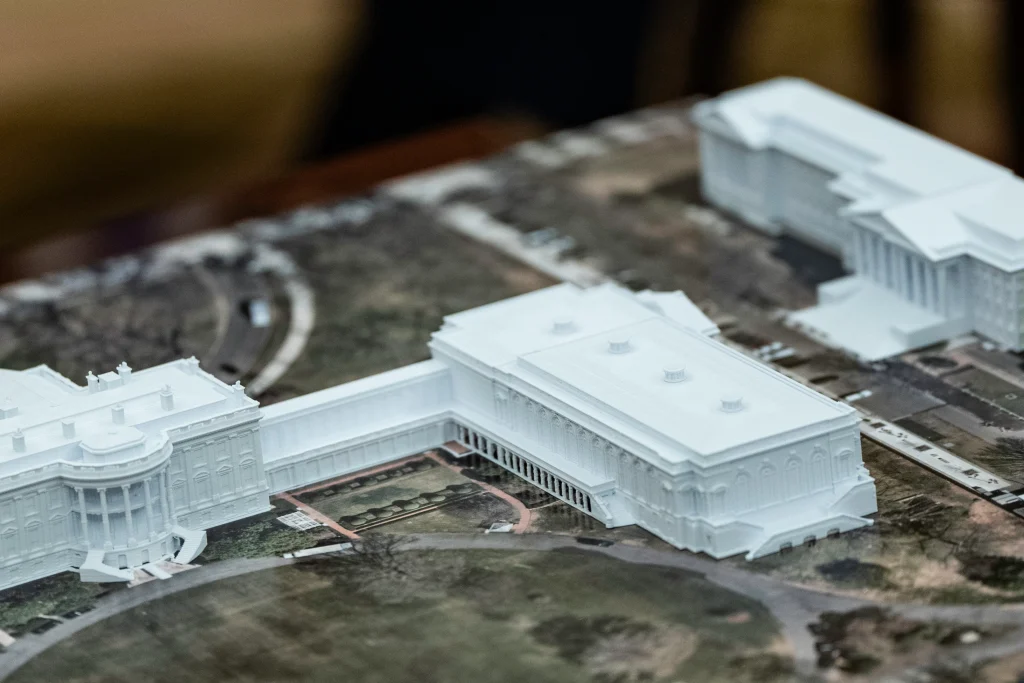
Yet the administration pressed forward, citing “mission-critical functionality,” “necessary security enhancements,” and “resilient, adaptive infrastructure.” White House officials, including Joshua Fisher, told the NCPC that the project addressed long-standing building constraints in a dense capital city increasingly vulnerable to modern threats. Construction was slated to begin in April 2026, with Trump promising the ballroom would be “the finest of its kind anywhere in the world” and even capable of hosting future presidential inaugurations.
The Underground Military Installation: A “Massive Complex” in the Shadows
What the public did not initially know – or at least what the administration preferred to keep classified – was that the ballroom sat atop a far more sensitive endeavor. Beneath the East Wing’s footprint lies the site of the Presidential Emergency Operations Center (PEOC), a bunker originally constructed during World War II under President Franklin D. Roosevelt. The PEOC gained fame on September 11, 2001, when Vice President Dick Cheney was rushed there during the terrorist attacks, and it has served as a secure command post during other crises, including the 2020 protests following George Floyd’s death.
Demolition of the East Wing in October 2025 dismantled parts of the aging PEOC infrastructure. In its place, the military began constructing what Trump later described as a “massive complex” – a modernized, fortified underground facility equipped to withstand contemporary threats. Details remain classified as a national-security matter, but Trump’s March 29 disclosure painted a vivid picture: the ballroom’s reinforced structure would act as an additional layer of protection, shielding the subterranean installation from drones, missiles, or other aerial attacks. “Everything is drone-proof and bulletproof,” he noted, adding that the military “wanted the ballroom more than anybody.”
Pentagon officials have declined to comment publicly, but administration sources describe the project as an upgrade to White House continuity-of-government capabilities. In an age of hypersonic weapons, cyber threats, and asymmetric warfare, the need for hardened facilities beneath the executive mansion is self-evident to proponents. The ballroom, in this framing, is not merely decorative; it is functional infrastructure – a “shed” that conceals and fortifies the true asset below. Trump himself framed the dual-use design as pragmatic: “We’re living in an age where that’s a good thing.”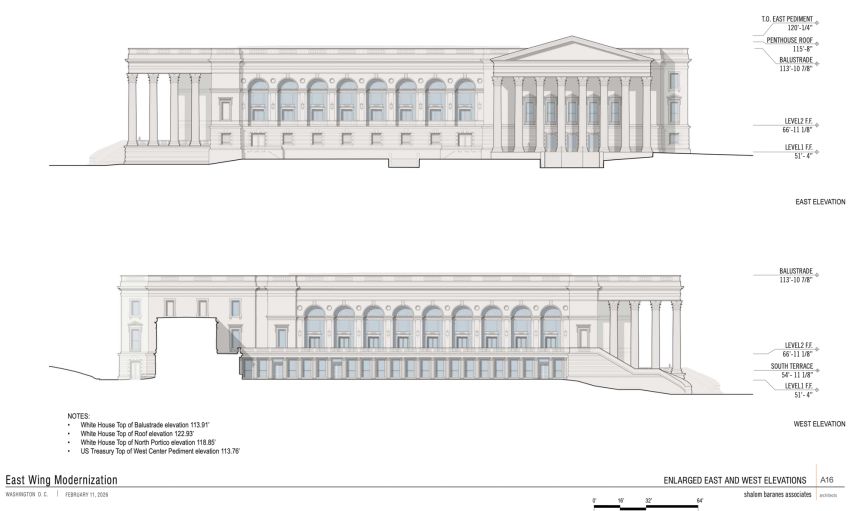
The administration has also proposed an additional 33,000-square-foot visitor screening facility beneath nearby Sherman Park, signaling a broader strategy of expanding secure underground space across the White House grounds while navigating surface-level building restrictions.
How the Secret Was Revealed: The “Stupid Lawsuit” That Changed Everything
The military dimension of the project was never intended for public discussion. Trump himself admitted as much on Air Force One: the information “has come out recently because of a stupid lawsuit that was filed.” That lawsuit, filed in December 2025 by the National Trust for Historic Preservation, accused the Trump administration of violating at least four federal laws by bypassing required environmental assessments, historic-preservation reviews, congressional authorization, and public input. The group sought a court order to halt construction until those processes were completed.
U.S. District Judge Richard Leon initially rejected the National Trust’s request for a preliminary injunction but left the door open for an amended complaint. Court filings and related proceedings inadvertently surfaced references to the underground military work, which the administration had classified. By March 2026, details of the “renovated bunker” beneath the ballroom had leaked into media reports, prompting Trump’s candid confirmation. He described the leakers as “unpatriotic” and insisted the project remained on track and ahead of schedule.
The timing was no coincidence. As the NCPC prepared to vote on final approval – a meeting originally set for early April – and with construction poised to accelerate, the lawsuit forced transparency. Preservationists argued that national-security claims could not override historic-preservation laws without proper oversight. The administration countered that stopping work would itself endanger national security, citing the classified nature of the underground elements.
As of April 1, 2026, the legal battle continues. Judge Leon is expected to issue a ruling imminently on whether to block the project temporarily. Meanwhile, the NCPC, chaired by a Trump ally, faces intense pressure. Public backlash has been fierce, yet Trump’s personal involvement and private funding have insulated the project from some traditional budgetary scrutiny.
Reactions: Praise, Outrage, and Strategic Silence
Reactions have split along predictable lines. Supporters, including many in the military and national-security community, view the integrated ballroom-and-bunker design as forward-thinking. In an era when the White House itself has been targeted – from the 2013 sniper attack on the exterior to drone incursions near restricted airspace – layered defenses are essential. Trump’s emphasis on private funding has also neutralized criticism from fiscal conservatives.
Critics, however, see hubris and overreach. Democrats and historic-preservation groups decry the demolition of the East Wing as cultural vandalism. “The White House belongs to the American people, not any one president,” one National Trust spokesperson argued. Environmental and urban-planning advocates worry about the precedent: bypassing NCPC and congressional review could erode safeguards for future projects. Some legal experts question whether private funding truly exempts the project from federal oversight when it occupies federal land and involves military construction.
The Pentagon’s silence is telling. No official statements have elaborated on the “massive complex,” underscoring its classified status. Yet the very fact that Trump chose to disclose it publicly – complete with show-and-tell renderings on Air Force One – suggests a calculated shift from secrecy to strategic transparency, perhaps to build public support or deter legal challenges by emphasizing national security.
Broader Context: White House Renovations Through History
The current project is hardly the first major intervention at 1600 Pennsylvania Avenue. Harry Truman’s 1948–1952 reconstruction gutted the interior while preserving the exterior, installing a new steel frame and modern utilities. The Truman Balcony, added in 1948, sparked similar outcry before becoming iconic. The West Wing has been expanded and fortified multiple times, most notably after the 1995 Oklahoma City bombing and post-9/11.
What sets Trump’s ballroom apart is its scale, speed, and explicit military integration. Previous upgrades focused on functionality or aesthetics; this one merges both with hardened infrastructure. In doing so, it reflects the evolving threat landscape: no longer just nuclear bunkers for the Cold War, but drone-resistant, cyber-secure facilities for 21st-century hybrid warfare.
Implications: Security, Legacy, and Democratic Norms
The ballroom-military complex carries profound implications. On the security front, it enhances presidential continuity and crisis response, potentially saving lives in an emergency. Yet it also raises questions about executive power. Can a president unilaterally transform a historic landmark into a fortified installation using private funds and classified military projects? The ongoing lawsuit will test the boundaries between national security and the rule of law.
Symbolically, the project cements Trump’s vision of a stronger, more resilient White House – one that projects grandeur above ground while hiding steel and concrete below. For supporters, it embodies decisive leadership. For detractors, it risks turning a people’s house into a fortress, further distancing the presidency from public access.
As the NCPC vote looms and court rulings pending, one thing is clear: the “shed” above the bunker is no ordinary ballroom. It is a statement – of luxury, of power, and of preparedness in uncertain times. Whether it stands as a triumph of modern governance or a cautionary tale of bypassed norms will be decided not just by renderings and court filings, but by the judgment of history.
Sources drawn from contemporaneous reporting by NBC News, People, Axios, Reuters, The Hill, USA Today, and official White House statements, March–April 2026.