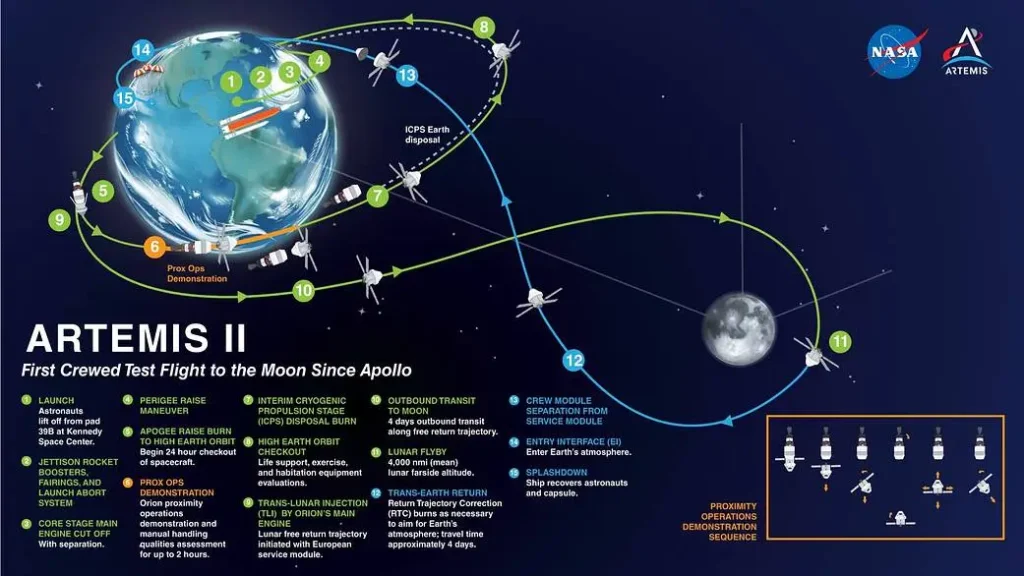

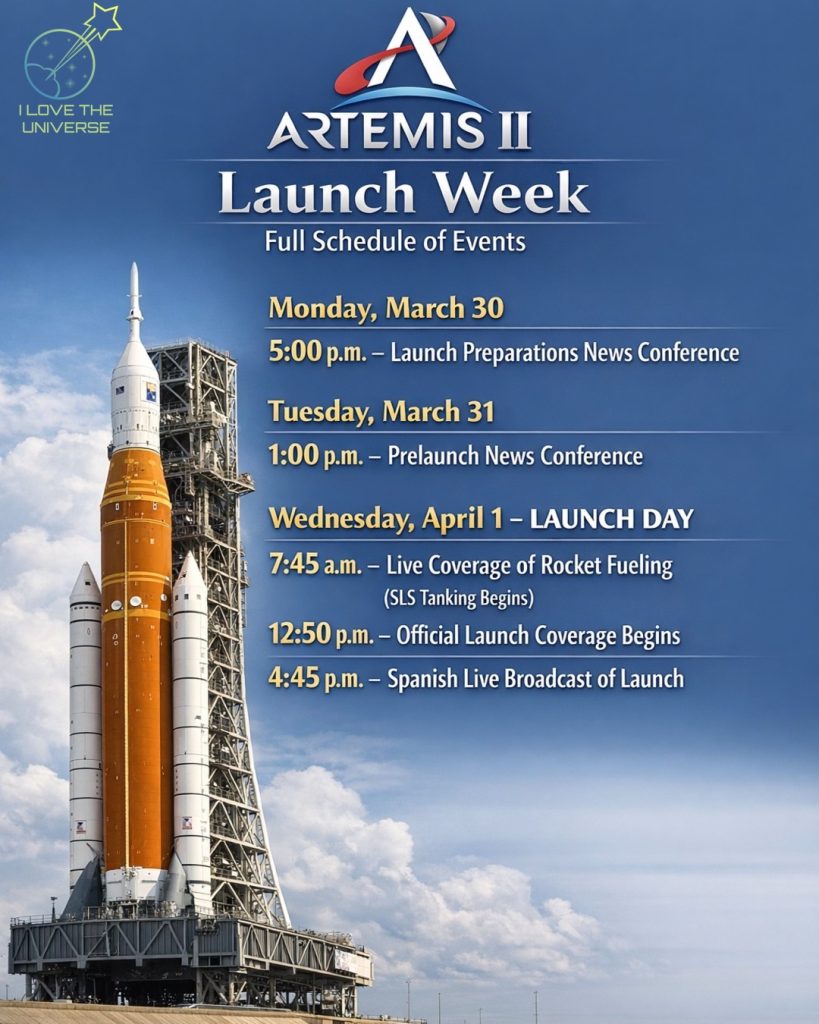
This week, on April 1, 2026 (with backup windows through April 6 and 30), NASA will launch Artemis II—the first crewed flight beyond low-Earth orbit since Apollo 17 in 1972. This 10-day lunar flyby (not a landing) will test the Space Launch System (SLS) rocket and Orion spacecraft ahead of future surface missions.
The SLS, NASA’s most powerful rocket, will lift off from Kennedy Space Center’s Launch Complex 39B at 6:24 p.m. EDT carrying four astronauts in the Orion capsule (nicknamed “Integrity”). The crew includes Commander Reid Wiseman, Pilot Victor Glover, Mission Specialist Christina Koch (all NASA), and Mission Specialist Jeremy Hansen (Canadian Space Agency). After launch, they will perform a series of Earth-orbit checks before a trans-lunar injection burn sends them on a free-return trajectory around the Moon.
The mission profile loops the crew past the Moon’s far side at a closest approach of about 4,000 miles (6,400 km), allowing them to see the lunar farside with their own eyes—the first humans to do so since the Apollo era. They will test life support, navigation, and emergency systems in deep space before splashing down in the Pacific Ocean around April 10.
Artemis II follows the uncrewed Artemis I test in 2022. Delays from hydrogen leaks and helium issues pushed the original February target to early April, but NASA confirmed in mid-March that the rocket is ready and countdown activities are underway.
This flight is a critical stepping stone. It paves the way for Artemis III/IV (targeted for crewed lunar landings by 2028) and long-term human presence on the Moon as a proving ground for Mars missions. For the first time in decades, humans will venture deep into space again—marking a new chapter in exploration.
The Crew
Commander Reid Wiseman (NASA)
Reid Wiseman, 50, from Baltimore, Maryland, leads the crew. A retired U.S. Navy captain and test pilot with 27 years of service, he flew F-14 Tomcats and F/A-18 Super Hornets, including combat deployments. Selected by NASA in 2009, he flew as a flight engineer on the International Space Station (ISS) during Expedition 41 in 2014, spending 165 days in space and conducting two spacewalks (nearly 13 hours total). He later served as chief of the NASA Astronaut Office. Wiseman holds a B.S. in computer and systems engineering from Rensselaer Polytechnic Institute and an M.S. in systems engineering from Johns Hopkins University. A single father of two teenage daughters after losing his wife to cancer in 2020, he has described parenting as his most rewarding challenge.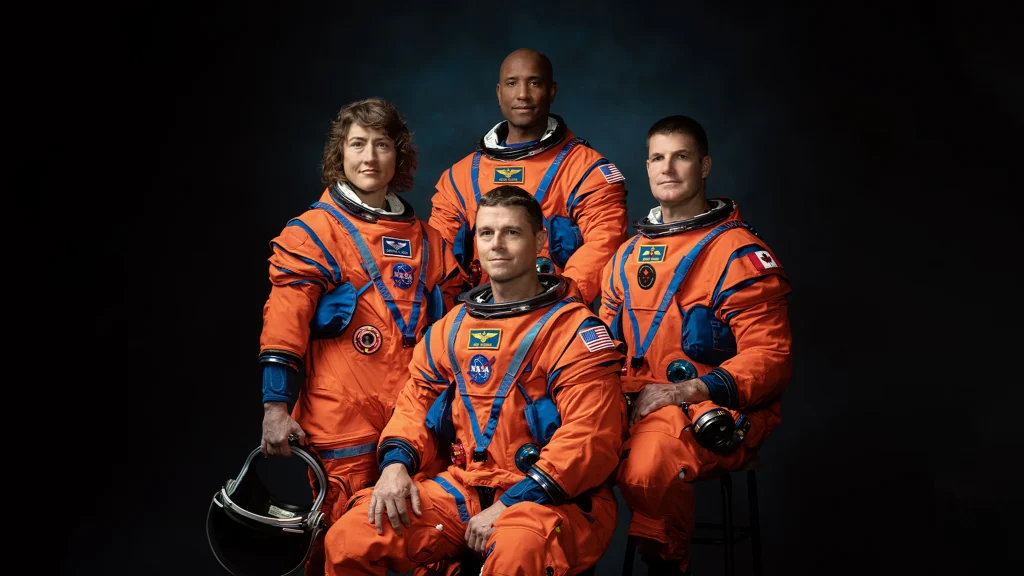
Pilot Victor Glover (NASA)
Victor Glover, 49, from Pomona, California, serves as pilot. A U.S. Navy captain, test pilot, and former combat pilot with over 3,000 flight hours in more than 40 aircraft, he flew F/A-18 missions in support of Operation Iraqi Freedom. Selected by NASA in 2013 while working as a legislative fellow in the U.S. Senate, Glover piloted the historic SpaceX Crew-1 mission in 2020—the first operational crewed flight of the Crew Dragon to the ISS. He spent 167 days aboard the station as part of Expedition 64, becoming the first Black astronaut to complete a long-duration ISS mission, and conducted four spacewalks. He holds multiple degrees, including a B.S. in general engineering from California Polytechnic State University and master’s degrees in flight test engineering, systems engineering, and military operational art and science. Glover and his wife have four daughters.
Mission Specialist Christina Koch (NASA)
Christina Koch, 47, from Grand Rapids, Michigan (raised in Jacksonville, North Carolina), is a mission specialist. An electrical engineer by training, she worked at NASA’s Goddard Space Flight Center on space science instruments and conducted field research in Antarctica (including a winter-over at the South Pole) and other remote sites before joining the astronaut corps in 2013. On her first spaceflight, she served as flight engineer on the ISS for Expeditions 59–61, spending a record 328 consecutive days in space—the longest single spaceflight by a woman. She also participated in the first
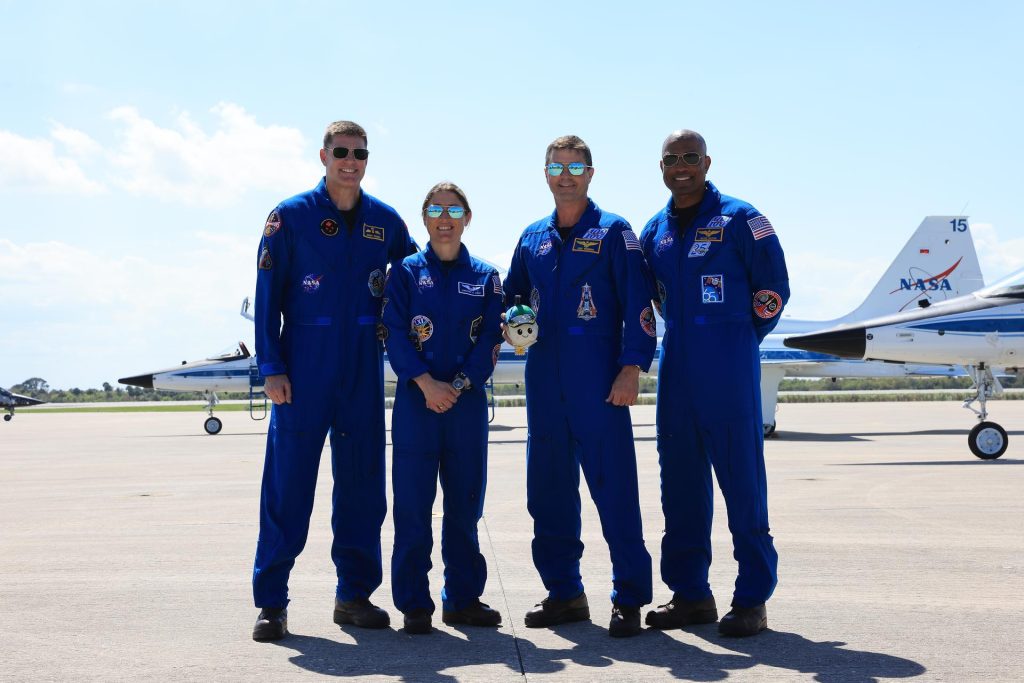
all-female spacewalk. Koch holds B.S. degrees in electrical engineering and physics, plus an M.S. in electrical engineering from North Carolina State University. She is married and has spoken about how her long-duration experience prepared her well for the relatively short Artemis II trip.
Mission Specialist Jeremy Hansen (Canadian Space Agency)
Jeremy Hansen, 50, from London, Ontario (raised on a farm near Ailsa Craig), is the fourth crew member and the first Canadian (and first non-American) to fly on a lunar mission. A colonel in the Royal Canadian Air Force and former CF-18 fighter pilot, he was selected as a CSA astronaut in 2009 alongside David Saint-Jacques. This will be his first spaceflight. Hansen holds a B.S. in space science (first-class honors) and an M.S. in physics from the Royal Military College of Canada. He has held leadership roles in astronaut training at NASA’s Johnson Space Center and brings expertise in physics and operational flying. Married with three children, he has reflected on the Apollo era’s inspiration while acknowledging the challenges of deep-space exploration.
This diverse crew—three NASA veterans and one international partner—represents a new era: the first woman (Koch) and first person of color (Glover) to travel beyond low-Earth orbit toward the Moon, plus international collaboration under the Artemis Accords. Their 10-day mission will test Orion’s systems in deep space while providing humanity’s first close-up views of the lunar far side in decades.
New Technologies and Spacecraft for Artemis II
Artemis II will mark the first crewed flight of NASA’s Space Launch System (SLS) rocket and Orion spacecraft, testing systems for deep-space human exploration beyond low-Earth orbit. The mission builds directly on the uncrewed Artemis I test in 2022, incorporating refinements for crew safety, performance, and future lunar landings.
The Space Launch System (SLS) Rocket – Block 1 Configuration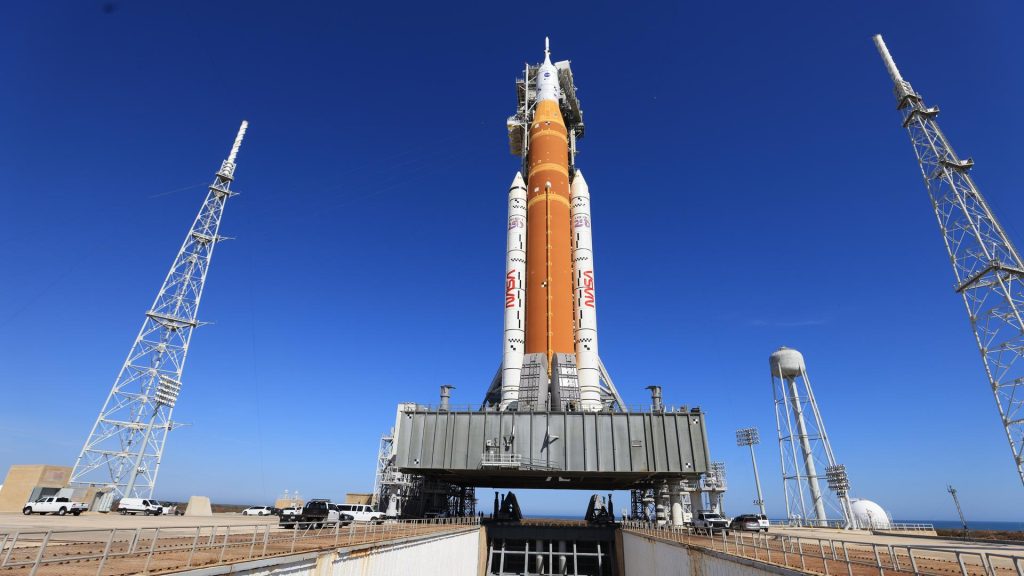
The SLS is NASA’s most powerful rocket, standing about 322 feet tall and weighing roughly 11 million pounds when fully fueled. For Artemis II, it uses the Block 1 design with:
- Two five-segment solid rocket boosters (built by Northrop Grumman) providing ~75% of liftoff thrust.
- A core stage powered by four RS-25 engines (upgraded Space Shuttle main engines).
- An Interim Cryogenic Propulsion Stage (ICPS) for the final push toward the Moon.
Recent upgrades include new aerodynamic strakes (fin-like structures) on the core stage to reduce vibration and improve stability during ascent. Engineers also replaced batteries across stages, refreshed the flight termination system, and addressed a helium flow issue in the ICPS that caused a February 2026 rollback to the Vehicle Assembly Building. The rocket will launch the crew on a multi-burn trans-lunar injection trajectory due to hydrogen boil-off considerations in the longer Earth parking orbit.
The Orion Spacecraft – “Integrity”
Orion, built by Lockheed Martin with the European Service Module (ESM) from Airbus/ESA, is the crew’s home, cockpit, and lifeboat. Key features include:
- Crew Module: Wider and more spacious than Apollo (~50% more volume), with a modern “glass cockpit” of digital displays operable even in microgravity. It includes a dedicated space toilet, advanced water dispenser, and a stowage area that doubles as a radiation shelter.
- Power: Four large X-shaped solar arrays (19 meters span, over 15,000 gallium arsenide cells) generating ~11.2 kW—enough for two average homes. This is the first NASA deep-space crewed vehicle to use solar power instead of fuel cells.
- Thermal Control: Radiators and cold plates maintain comfortable temperatures amid extreme swings (-200°C to +200°C).
- Redundancy & Safety: Five independent flight computers, multiple redundant propulsion, power, and life-support systems, plus the Launch Abort System for pad or ascent emergencies. The heat shield is the largest ever built for human spaceflight.
The spacecraft is designed for manual control by the crew, including rendezvous and proximity operations demonstrations with the spent ICPS as a target.
Cutting-Edge Technologies Being Tested
- Life Support Systems: Fully operational environmental control for the 10-day mission, including oxygen, CO₂ removal, humidity, and temperature regulation—critical validation for longer future missions.
- Optical Communications (O2O): The Orion Artemis II Optical Communications System uses a laser terminal (4-inch telescope) to demonstrate high-speed data transfer up to 260 Mbps—far faster than traditional radio. This could enable high-resolution video and science data from deep space.
- AVATAR Payload: “Organ-on-a-chip” technology that mimics human tissue responses to radiation and microgravity, providing data on deep-space health effects beyond the Van Allen belts.
- Navigation & Guidance: Enhanced systems for deep-space operations, including star trackers and manual flying capabilities.
- Proximity Operations: Crew will test automated and manual rendezvous techniques.
These technologies address challenges like radiation, communication delays, and life support in cislunar space, paving the way for Artemis III landings and eventual Mars missions. Recent preparations confirm the stack is at Launch Complex 39B with final countdown activities underway for the April 1, 2026 target.
As Artemis II prepares to launch this week, we stand on the threshold of one of the most inspiring moments in modern space exploration. Four extraordinary astronauts—Reid Wiseman, Victor Glover, Christina Koch, and Jeremy Hansen—will climb aboard the powerful Space Launch System rocket and the advanced Orion spacecraft for humanity’s first crewed journey beyond low-Earth orbit in more than fifty years.
This 10-day lunar flyby is far more than a test mission. It represents a bold step forward in our shared quest to become a multi-planetary species. With cutting-edge technologies—including Orion’s spacious crew module, powerful solar arrays, high-speed laser communications, and innovative health-monitoring experiments—the mission will prove that we are ready to safely explore deeper into space than ever before.
For the first time in decades, humans will once again see the far side of the Moon with their own eyes. This voyage carries the dreams of an entire generation and opens the door to sustainable lunar presence and, eventually, crewed missions to Mars.
Artemis II reminds us that exploration is one of humanity’s greatest strengths. It shows what we can achieve when we work together across nations, push the boundaries of technology, and dare to dream big. As the rocket lifts off from Kennedy Space Center, it will carry not just four brave astronauts, but the hopes and aspirations of all humankind.
The future is bright. The Moon is calling—and we are finally ready to answer.
References
- NASA Official Artemis II Mission Page
- Wikipedia Artemis II Entry (sourced from NASA/ESA data)
- Space.com and Lockheed Martin Orion Features
- Financial Express and Technology Magazine coverage of Artemis II technologies (March 2026)
- Boeing and Northrop Grumman SLS/Orion updates
- NASA Official Artemis II Crew Page and Individual Astronaut Biographies
- Canadian Space Agency Jeremy Hansen Profile
- Recent mission coverage from CNN, Space.com, and Houston Chronicle (March 2026 updates)
- NASA Official Artemis II Mission Page
- NASA Artemis II Launch Countdown Updates (March 2026)
- Space.com Live Coverage of Artemis II Preparations
- Wikipedia Summary of Artemis II (sourced from NASA data)
- Planetary Society Artemis II Mission Overview